

Frailty is an increasingly recognised syndrome that signifies increased risk of adverse outcomes such as unplanned hospital admission, institutionalisation and death. There is good evidence that intervention can improve the outcomes for these patients.
NB. Please note that some frail patients are not elderly so the term frail, rather than frail elder, is used throughout. Also note that many frail patients are not housebound.
Accessing the Populating Reporting Searches
To access the CDRC Frailty Population Reporting Searches on EMIS, you will need to download and import the following .zip file:
If you have not performed this process before, please refer to the Download/ Import guide below, which provides you with step-by-step instructions on how to Download and Import .zip files into EMIS:
You can check whether you have the most up-to-date version by reviewing the date on the .zip file. Any updates to the Population Reporting searches will be communicated to CDRC Precision users via the mailing list for the CDRC. To ensure you stay up to date with the latest information, please sign up to the mailing list at http://eepurl.com/9131L
Guidance on the Population Reporting Searches
The eFI is a tool that counts the number of ‘deficits’ that a patient has, based on Read coded information. It has been validation in an enormous UK cohort. The eFI gives a value of 0-1. Values above 0.75 are, by and large, incompatible with life. Values above 0.36 suggest significant frailty. The eFI correlates strongly with outcomes such as hospitalisation, institutionalisation and death. The small proportion of patients with a high eFI who are not frail are at high risk of hospital admission and may still be candidates for the avoiding unplanned admission scheme.
NB. A high eFI does not confirm a diagnosis of frailty.
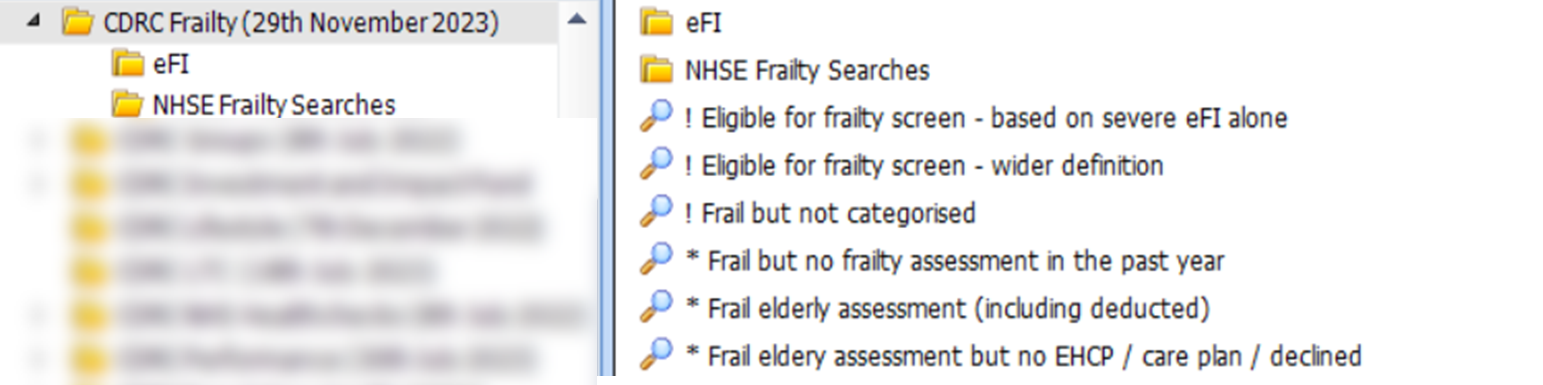
| Report Name | Report Returned |
|---|---|
| ! Eligible for frailty screen – based on eFI alone | Patients eligible for a frailty screen based on a eFI score of >=13. |
| ! Eligible for frailty screen – wider definition (severe eFI, >90, dementia, housebound, palliative care) | Patients eligible for a frailty screen based on age over 90, patients in care homes or sheltered accommodation and patients in the palliative care list as well as those with an eFI in the severe range. |
| ! Frail but frailty not categorised | Patients coded as Frail but severity has not been recorded. |
| * Frail but no frailty assessment in past year | Patients coded as Frail without an assessment in the last year. |
| * Frail elderly assessment (including deducted) | Patients coded with having a frail elderly assessment, including active, deceased and deducted patients. |
| * Frail elderly assessment but no EHCP/care plan/ declined | As above excluding patients with a frailty assessment and EHCP in the last year. |