


• Skip to main content
  • Skip to secondary menu
  • Skip to footer
Clinical Digital Resource Collaborative

Clinical Digital Resource Collaborative

Designed and developed in the North East and North Cumbria by local GPs

National Health Service
  • Home
  • About Us
  • Our Team
  • What We Offer
    • Primary Care
    • Commercial
  • Resources
    • Referral Forms
    • EMIS Resources
      • CDRC EMIS Access
      • EMIS: Long Term Condition (LTC) Management
      • Medicine Management
        • EMIS: Precision Monitoring Template
        • EMIS: DMARDs and High Risk Drugs
        • EMIS: Safe Prescribing of Opioids / Opiates
      • Specialties
        • EMIS: Cancer
        • EMIS Cardiovascular Overview
          • EMIS: Cardiovascular Disease (AF, CHD, Hypertension)
          • EMIS: Cardiovascular Disease (CVD) Prevention
          • Lipids, Familial Hypercholesterolaemia (FH), PCSK9i & Inclisiran Guide for EMIS
          • EMIS: Peripheral Arterial Disease Guide
        • EMIS Diabetes Overview
          • EMIS Diabetes
          • EMIS: Diabetes Technology
        • EMIS: Care for Frail Patients
        • EMIS: Haematology
        • Infection
          • EMIS: Infections Guide
          • EMIS: Blood Borne Virus (BBV)
        • EMIS: Learning Disabilities
        • EMIS: Neurology Guide
        • EMIS: NHS Health Checks
        • EMIS: Paediatric Assessment
        • EMIS Renal Overview
          • Chronic Kidney Disease (CKD) – EMIS
        • Respiratory Overview
          • EMIS Respiratory Resources
          • BeatAsthma+ Guide for EMIS
        • EMIS: Rheumatology
    • SystmOne Resources
      • National Early Warning Score 2 (NEWS2) Guide for SystmOne
      • Getting Started
        • Getting Started – Access
        • Getting Started – How-To’s
      • SystmOne Administration
      • Contract Management
        • Impact and Investment Fund (IIF)
        • Quality and Outcomes Framework (QOF) Guidance for 2023/24
        • SystmOne: NHS Health Checks
        • SystmOne: WorkWell Local Enhanced Service
      • Long Term Condition Management
        • Call/ Recall System
        • Recall Recovery System
        • Care Planning
      • SystmOne Safeguarding System
        • Safeguarding Adults
        • Safeguarding At Risk of Harming Others
        • Safeguarding Family/Household Cause for Concern
        • Safeguarding Children
      • Medicine Management
        • Drugs Requiring Monitoring System
        • SystmOne: Antibiotics Prescribing & Optimisation
        • Safety & Reviews
        • Safe Prescribing of Opioids / Opiates
        • Safe Prescribing of NSAIDS
        • Safe Prescribing of Lithium
        • Safe Prescribing of Valproate
        • Safe Prescribing of Corticosteroids / Steroids
      • Specialties
        • Blood Borne Virus (BBV) Test Alert for SystmOne
        • BeatAsthma+ Guide for SystmOne
        • Cancer Overview
          • Cancer
          • Suspected Cancer
        • Cardiovascular Overview
          • Cardiology Results
          • Hypertension & Blood Pressure
          • SystmOne Heart Failure
          • Atrial Fibrillation (AF)
          • Integrated CVD Prevention
          • Peripheral Arterial Disease (PAD)
        • SystmOne Diabetes Overview
          • SystmOne Diabetes
          • SystmOne: Diabetes Technology
          • SystmOne Diabetic Kidney Disease
        • ENT Infections
        • Geriatrics Overview
          • SystmOne: Care for Frail Patients
          • Comprehensive Geriatric Assessment
          • Co-ordinated Care
        • Haematology
        • Infection Overview
        • Learning Disabilities
        • Lifestyle
        • Lipids, Familial Hypercholesterolaemia, PCSK9i & Inclisiran Overview
          • Lipids, Familial Hypercholesterolaemia (FH), PCSK9i & Inclisiran Report Guide for SystmOne
          • Lipids Protocols
          • Lipid Management Templates
          • Lipid QoF Support
          • Screening for Familial Hypercholesterolaemia
          • Aetiology of Abnormal Lipids
          • Lipids Strategy
        • MSK Referral Management
        • Neurology
        • Obesity Resources
        • Ophthalmology
        • Palliative Care
        • SystmOne Renal/Urology Overview
          • Chronic Kidney Disease (CKD)
        • Respiratory Overview
          • Respiratory Resources
          • Respiratory Infections
        • Rheumatology Overview
          • SystmOne: Osteoporosis and Fragility Fractures
          • Bone Health
      • SystmOne: Weight Management
      • Women’s Health Overview
        • Gynaecology Resource Overview
          • Cervical Screening
          • Contraception
          • Prolapse
        • 6-8 Week Postnatal Check
      • Vaccination Overview
        • COVID-19 Resources- SystmOne
        • Influenza Vaccination SystmOne
        • Meningitis B Vaccination
        • Meningitis ACWY Vaccination
        • Pneumococcal Vaccination
        • Shingles Vaccination
  • FAQs
  • News and Events
    • Demonstrations
    • Events
      • Recordings
    • Articles
    • Conference abstracts
  • Contact us
You are here: Home / Resources / SystmOne Resource Centre / SystmOne Specialties / BeatAsthma+ Guide for SystmOne

BeatAsthma+

The Beat Asthma+ Project is a feasibility study, aiming to objectively assess a new approach to managing children aged 5-18 years with more difficult asthma in primary care. The Beat Asthma+ Pathway aims to improve outcomes for asthmatic children and ultimately prevent further asthma deaths.

Use of the Beat Asthma+ templates developed by CDRC Precision will enable early identification and management optimisation of children with ‘higher risk’ asthma. The pathway involves the delivery of an intensive education programme to children and their families over a 12 month period and will be implemented across 8 GP surgeries from Newcastle, Gateshead, North Tyneside and South Tyneside CCG’s.

The Primary objective of the study is to demonstrate a reduction in the number of children presenting to hospital with an asthma exacerbation.

Secondary objectives include:

  • Improvement in the percentage of patients having a personalised asthma action plan
  • Reduction in the average number of reliever inhalers used per patient per year
  • Improvement in the average number of preventer inhalers used per patient per year
  • Reduction in the average number of courses of steroids used acutely per patient per year

We will also measure:

  • Attendance and DNA rates to clinics
  • QOL scores in patients pre and post intervention
Beat Asthma+ Report, Access and Guide

Access:

If you are not already member of the DCS organisational group on SystmOne, please refer to Access Guide here.

Once you have access, you will be able to use the resources highlighted on below.

Guide:

The Beat Asthma+ Report is found in the folder CDRC Quality > Respiratory

It is called ” ? BEATAsthma 1 – Trigger Criteria ” as highlighted below.
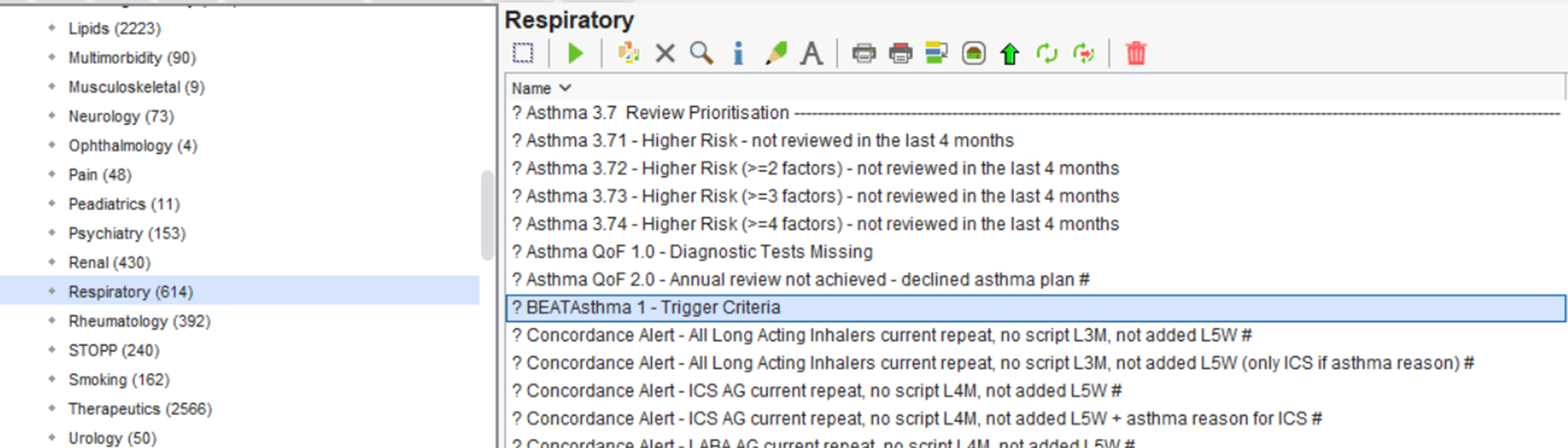
You will first need to run this report. Right-click on this report and press ‘Run’. This may take a few moments depending on the size of your unit’s population.
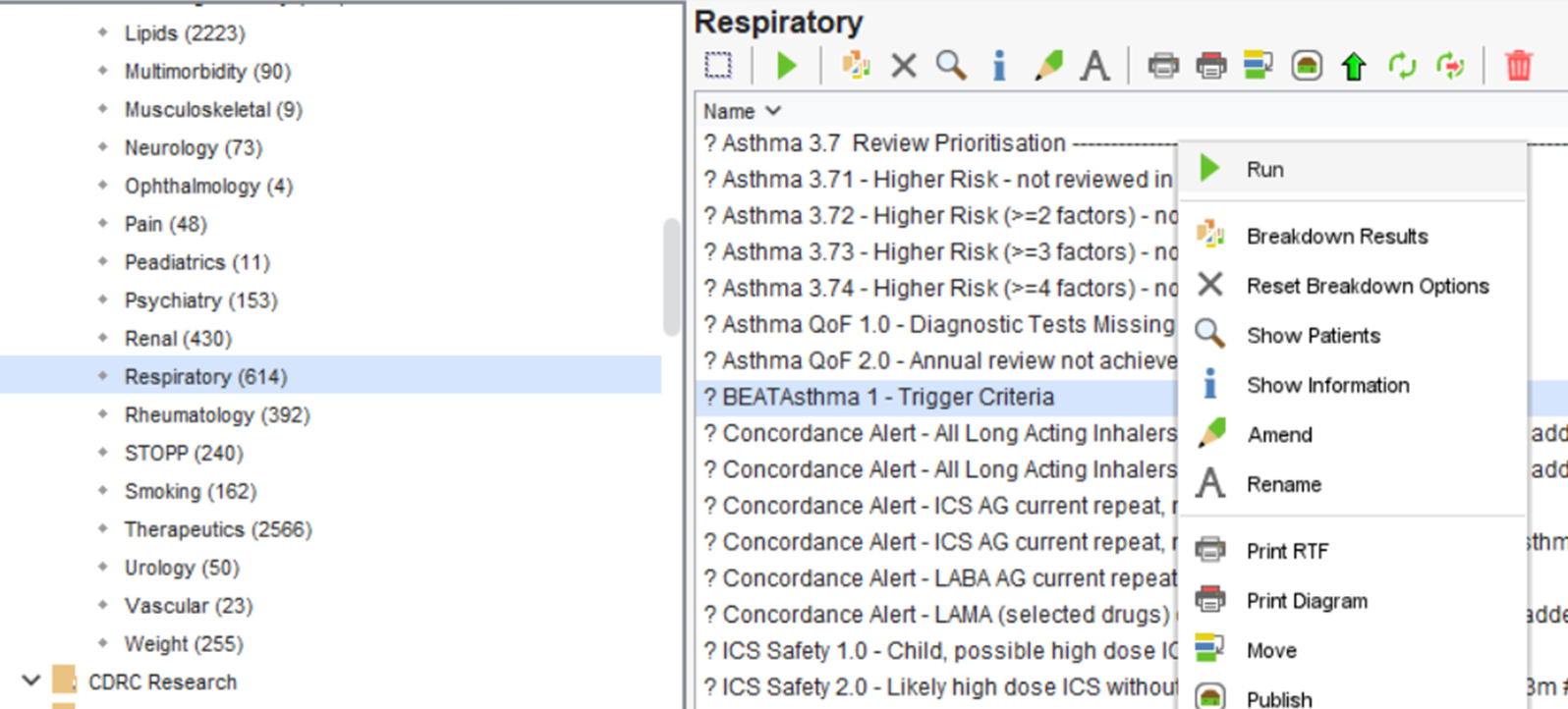
Once this report has been ran, you can view the patient’s returned.

To do this, right-click on the ? BEATAsthma 1 – Trigger Criteria report and click on ‘ Show Patients’.
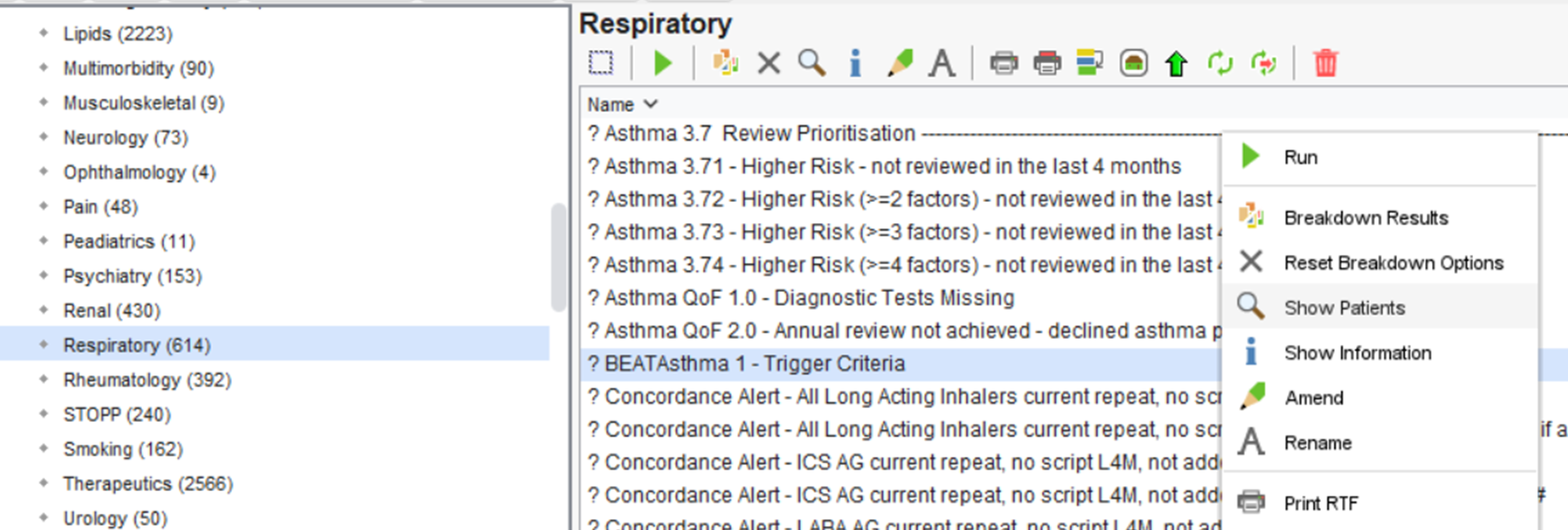
This will show the patient’s identified from this search.

You can view, and save this patient list as an Excel document by clicking on ‘Save All Pages to CSV’.

This will automatically open up an Excel spreadsheet with the patients identified from this search. If you send this patient list, please ensure all patient identifiable information is removed prior to sending.

Beat Asthma+ Template

In addition to the Beat Asthma+ Report above, the CDRC has developed an Asthma BEATAsthma Data Entry Template available to all units that are a member of the DCS organisational group on SystmOne.

To access this template, with an identified patient’s record retrieved, using the search bar in the lower left-hand corner of the SystmOne screen, type in Asthma BEATAsthma and select the highlighted template.
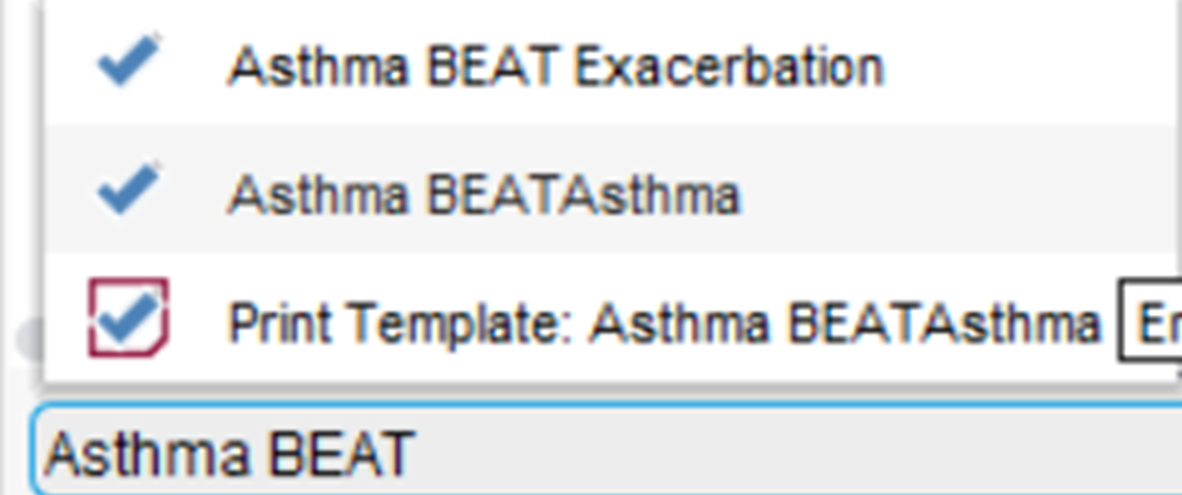
This template has a number of pages which provide valuable information and allows you to input information directly onto the patient’s record.

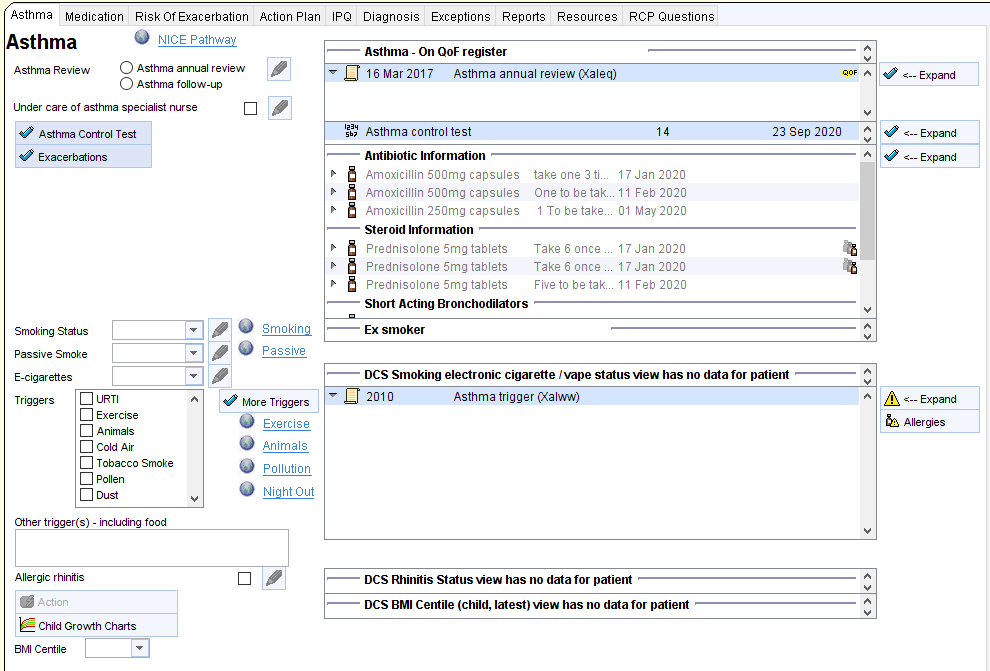
Asthma

The main asthma page provides an overview of current asthma issues. It is set out in three columns: a column to record important information or link to other templates; a column to show important information and warnings; a column to show expanded information from the record.  
Asthma Medication Risk Of Exacerbation 
Asthma 
Asthma Review 
O NICE Pathway 
C) Asthma annual review 
C) Asthma follow up 
Action Plan 
Smokina 
Passive 
IPO Diagnosis Exceptions Reports Resources 
Asthma - On QoF register 
16 Mar 201 7 Asthma annual review (Xaleq) 
Under care of asthma specialist nurse 
Asthma Control Test 
Exacerbations 
Smoking Status 
Passive Smoke 
E-cigarettes 
Triggers LIRTI 
Exercise 
Animals 
D Air 
Tobacco Smoke 
Other trigger(s) - including food 
Allergic rhinitis 
Action 
Child Growth Chans 
SMI centile 
Asthma control test 
Antibiotic Information 
Amoxicillin 500mg capsules 
Amoxicillin 250mg capsules 
Steroid Information 
Prednisolone 5mg tablets 
Short Acting Bronchodilators 
Ex smoker 
take one 3 tL 
One to be tak 
1 To be tak4 
Take 6 once 
Take 6 once 
Five to be tak 
RCP Questions 
17 2020 
11 Feb 2020 
01 May 2020 
17 2020 
17 2020 
11 Feb 2020 
23 sep 2020 
DCS Smoking electronic cigarette /vape status view has no data for patient 
2010 
Asthma trigger (Xalww) 
Expand 
Expand 
Expand 
Expand 
Allergies 
More Triggers 
Exercise 
Niaht Out 
DCS Rhinitis Status view has no data for patient 
DCS BMI Centile (child, latest) view has no data for patient

The following information is shown in the middle column: 

  • Asthma status (i.e. never had asthma, suspected asthma, previous asthma, current asthma, on asthma QoF register) 
  • Latest asthma control test score and date 
  • Relevant medication information eg antibiotic and steroid use 
  • Smoking Status 
  • Current Triggers recorded 
  • Rhinitis status 
  • BMI Centile  
  1. Current Symptoms 

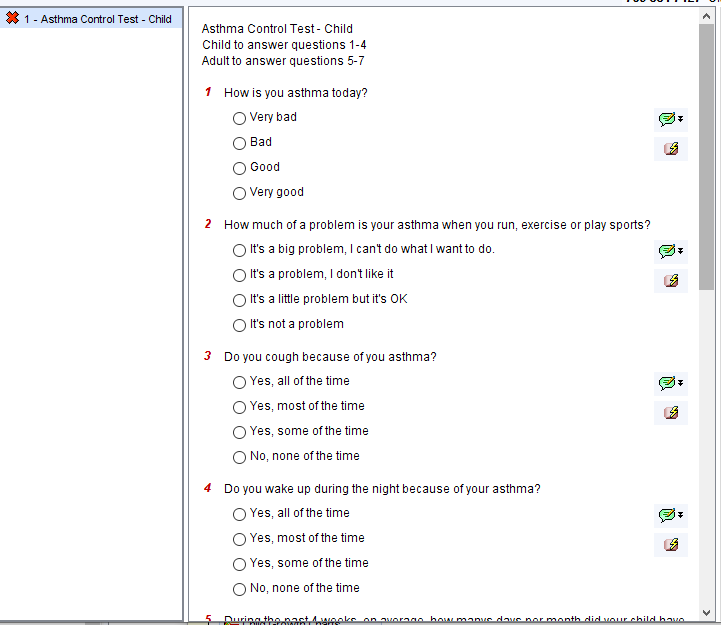
The Asthma Control Test (ACT) protocol takes you through the relevant questionnaire to calculate the ACT score.   

Once completed, click the Save Final Version button above the questionnaire.  The ACT score and associated symptoms codes will be recorded automatically.  The ACT score will then show on the main template. 

If needed, the ACT score can be manually recorded (e.g. if the patient has completed a paper ACT questionnaire) in the boxes on the template 

The ACT questionnaire can be completed by the patient in SystmOnline ahead of the asthma review. 
- Asthma Control Test - Child 
Asthma Control Test- Child 
Child to answer questions 1-4 
Adult to answer questions 5-7 
How is you asthma today? 
O Very bad 
O Good 
O Very good 
How much of a problem is your asthma when you run, exercise or play sports? 
3 
4 
O It's a big problem, cant do what want to do 
O It's a problem, dont like it 
O It's a little problem but it's OK 
O It's nota problem 
Do you cough because ofyou asthma? 
O Yes, all ofthe time 
O Yes, most ofthe time 
O Yes, some ofthe time 
O No, none ofthe time 
Do you wake up during the night because ofyour asthma? 
O Yes, all ofthe time 
O Yes, most ofthe time 
O Yes, some ofthe time 
O No, none ofthe time
  1. Exacerbations – A questionnaire to guide you through exacerbation history, prompting the relevant questions to ask the patient/family. 
Asthma Exacerbation Questionn 
Asthma Exacerbation Questionnaire 
11 
In the past 4 weeks, how many times a day on average did you use a reliever? 
How long does a reliever last (in weeks)? 
How many asthma attacks in the past 12 months? 
How many courses of prednisolone in the past 12 months? 
How many urgent care or A+E attendances for asthma in the past 12 months? 
How many hospital admissions for asthma in the past 12 months? 
In the previous 12 months have you been admitted to HDL] or ITO? 
O Yes 
O No 
In the past 12 months have you needed M drugs for your asthma? 
O Yes 
O No 
Any other comments 
Finish
  1. Smoking Status – including passive and e-cigarette use 
  1. Triggers – Current asthma triggers can be recorded here.  The middle column shows the latest recorded trigger and the button in the third column shows all previous triggers. 
  1. Current Action Plan (if exists) 
  1. Child Growth Charts and BMI Centile recording 
Medication
Asthma \ Medication* Risk Of Exacerbation Action Plan 
Asthma Treatment Compliance 
Asthma Rx Algorthm 
Riaht Breathe Website 
Diagnosis Exceptions Reports Resources RCP Questions 
EXACERBATION IN LAST 2YBUT NO RECENT ICS ISSUE 
Codeine 30mg tablets 
11 Dec 
2 tab„ 84 ta 
Inhaler technique 
- good (6634) 
Inhalers 12m 
Meds Timeline 
Inh Technique 
Inhaler Technique 
Inhaler Technique Shown 
Spacer use 
16 Mar 2017 
o 
Spacer used 
o 
Spacer not used 
History: Presenting complaints or issues 
Steroid Safetyffontoring 
Prednisolone 5mg tablets 
Take 6 once 
Take 6 once 
Five to be tak 
17 Jan 2020 
17 2020 
11 Feb 2020

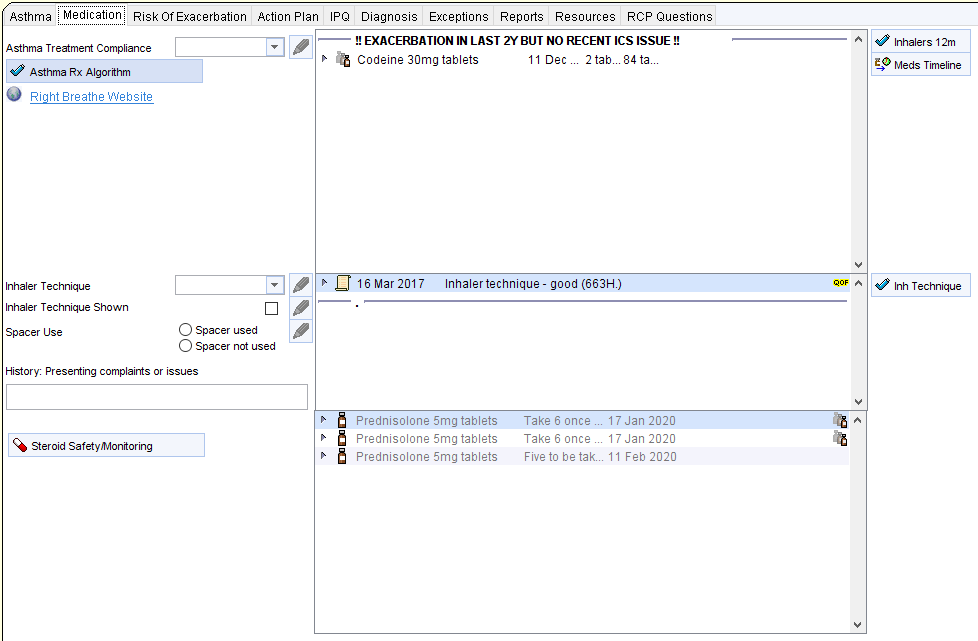
The Medication page helps you to:  

  • Record concordance/compliance 
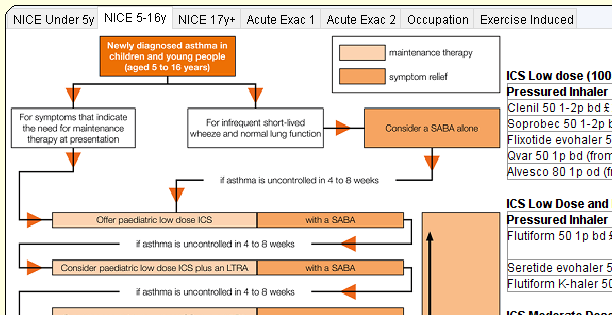
  • Links to national guidance (built directly within the template): 
NICE under 5M 
th«agy al 
NICE 5-16M NICE 
Newly in 
chilCren and young people 
16 
Acute Exac 1 
Acute Ekac2 Occupation Exercise Induced 
relkl 
a SABA 
is in to 
ICS 
p—iGtric dose ICS pus LIRA 
t uromtrs;lbd in 4 ta B 
ICS Low dose (100 
ressured Inhaler 
lenil 50 1-2P 
oprobec 50 1-2pE 
lixotide evohaler 5 
var 50 Ip bd (from 
Ivesco 80 Ip od(fl 
ICS Low Dose and 
ressured Inhaler 
lutiform 
50 Ipbd± 
eretide evohaler 5 
lutiform K-haler 51:
  • Link to the Right Breathe website which has extensive information about inhalers, spacers, pathways and really useful videos of inhaler techniques for all devices. 
  • Record inhaler technique and spacer use: 
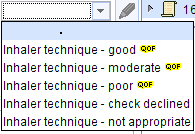
Inhaler technique- good 
Inhaler technique - moderate 
Inhaler technique- poor Q 
Inhaler technique - check declined 
Inhaler technique - not appropriate
  • The middle column of the Asthma Medication template shows:
    • Latest recorded compliance 
    • Current asthma medication 
    • A alert to show if the patient has rhinitis 
    • The following warnings:
      • Patients receiving excessive SABA issues 
      • Patients with an exacerbation in the past 24m who are not receiving ICS 
      • Patients who appear to be overusing preventers 
      • Patients with an apparently unlicensed inhaler 
      • Patients with inappropriate generic repeats 
      • Patients who appear to have low concordance for non-ICS preventers 
    • Latest record of inhaler technique and demonstration 
    • Latest information about spacer use 
    • An alert to suggest spacer issue if the patient is on a preventer that is compatible with a spacer which has not been issued in the past 18 months.  
  • The buttons in the third column show more detailed information about medication issues:
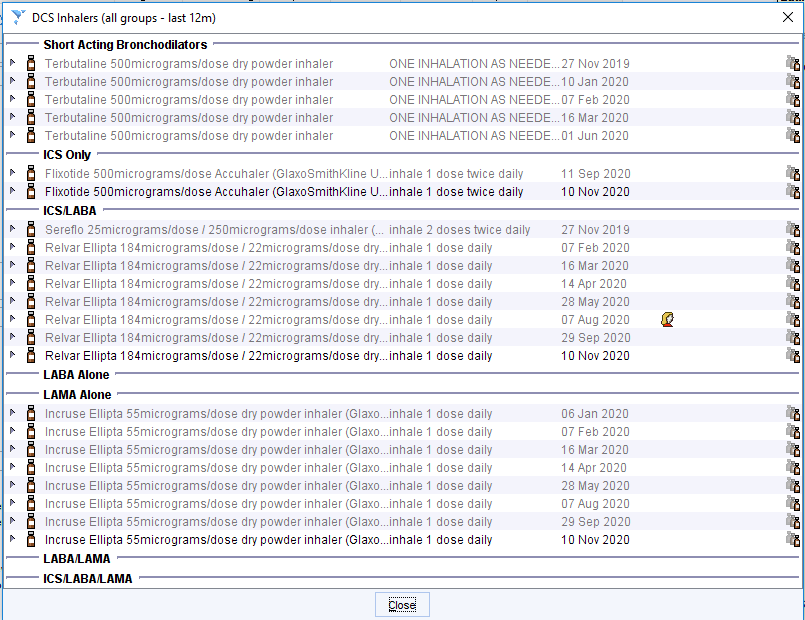
OCS Inhalers (all groups - last 12m) 
Short Acting Bronchodilators 
Terbutaline 500micrograms/dose dry powder inhaler 
ONE INHALATION AS 
Terbutaline 500micrograms/dose dry powder inhaler 
ONE INHALATION AS 
Terbutaline 500micrograms/dose dry powder inhaler 
ONE INHALATION AS 
Terbutaline 500micrograms/dose dry powder inhaler 
ONE INHALATION AS 
Terbutaline 500micrograms/dose dry powder inhaler 
ONE INHALATION AS 
ICS only 
Flixotide 500micrograms/dose Accuhaler (GlaxoSmithKline inhale 1 dose twice daily 
Flixotide 500micrograms/dose Accuhaler (GlaxoSmithKline U inhale 1 dose twice daily 
ICS'LABA 
Sereflo 25micrograms/dose / 250micrograms/dose inhaler 
inhale 2 doses twice daily 
Relvar Ellipta 184micrograms/dose / 22micrograms/dose 1 
dose daily 
Relvar Ellipta 184micrograms/dose / 22micrograms/dose 1 
dose daily 
Relvar Ellipta 184micrograms/dose / 22micrograms/dose 1 
dose daily 
Relvar Ellipta 184micrograms/dose / 22micrograms/dose 1 
dose daily 
Relvar Ellipta 184micrograms/dose / 22micrograms/dose 1 
dose daily 
Relvar Ellipta 184micrograms/dose / 22micrograms/dose 1 
dose daily 
Relvar Ellipta 184micrograms/dose / 22micrograms/dose dry n inhale 1 
dose daily 
LABA Alone 
LAMA Alone 
Incruse Ellipta 55micrograms/dose dry powder inhaler 1 
dose daily 
Incruse Ellipta 55micrograms/dose dry powder inhaler 1 
dose daily 
Incruse Ellipta 55micrograms/dose dry powder inhaler 1 
dose daily 
Incruse Ellipta 55micrograms/dose dry powder inhaler 1 
dose daily 
Incruse Ellipta 55micrograms/dose dry powder inhaler 1 
dose daily 
Incruse Ellipta 55micrograms/dose dry powder inhaler 1 
dose daily 
Incruse Ellipta 55micrograms/dose dry powder inhaler 1 
dose daily 
Incruse Ellipta 55micrograms/dose dry powder inhaler (Glaxo ninhale 1 
dose daily 
LABAYLAMA 
ICS'LABAYLAMA 
Apse 
27 Nov 201g 
10 dan 2020 
07 Feb 2020 
16 Mar 2020 
01 dun 2020 
11 sep 2020 
10 Nov 2020 
27 Nov 201g 
07 Feb 2020 
16 Mar 2020 
14 Apr 2020 
28 May 2020 
07 Aug 2020 
sep 2020 
10 Nov 2020 
06 dan 2020 
07 Feb 2020 
16 Mar 2020 
14 Apr 2020 
28 May 2020 
07 Aug 2020 
sep 2020 
10 Nov 2020

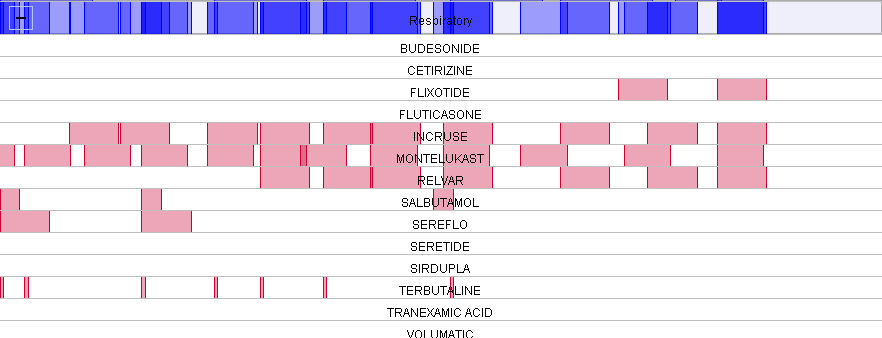
The medication timeline function helps highlight medication concordance and what has been tried before: 
BUOESONIOE 
CETIRIZINE 
FLIXOTIOE 
FLUTICASONE 
CR SE 
MO TE UKAS 
SALB 
MOL 
SERETIOE 
TERBUT LINE 
TRANEXAMIC ACID

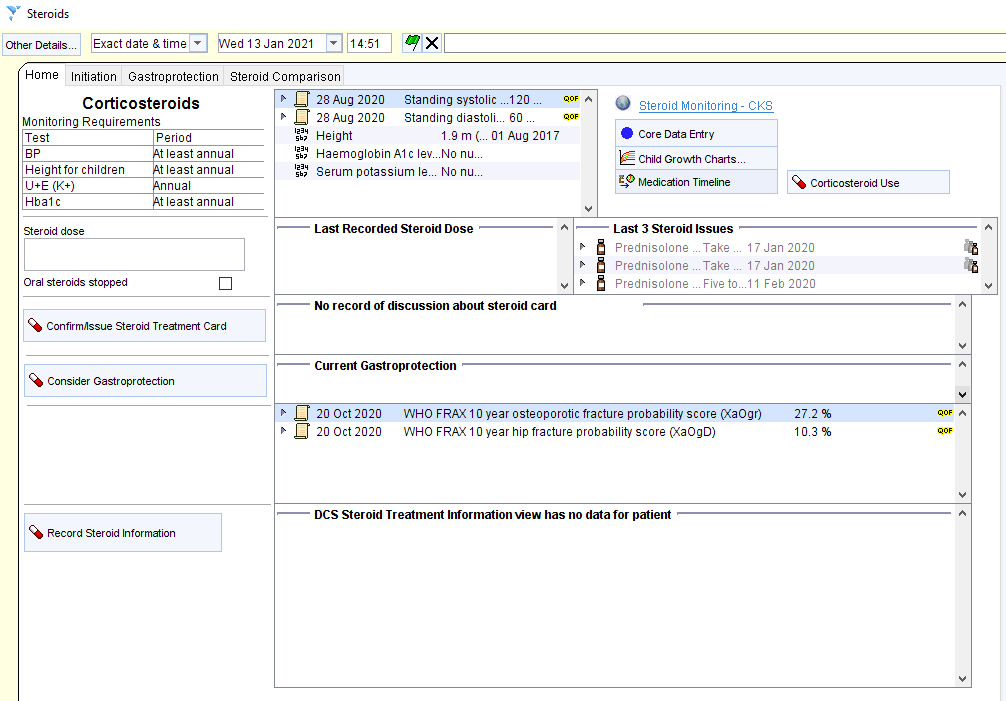
The steroid safety section helps to promote safe use of oral and inhaled corticosteroids. 

The steroid safety button links to a steroid monitoring template which helps to give an overview of use of corticosteroids over time, along with safety and monitoring information (NB: template used across multiple clinical areas, not just Asthma): 
Ster aids 
Other Details 
Exact date & time • 
ed 2021 
Steroid Comparison 
14:51 
Home Initiation Gastroprotection 
Corticosteroids 
Monitoring Requirements 
28 Aug 2020 
28 Aug 2020 
Height 
Standing systolic 
120 
Standing 
60 
1 01 Aug 2017 
Test 
Height for children 
Hbalc 
Steroid dose 
Oral steroids stopped 
Period 
t least annual 
t least annual 
nnual 
t least annual 
Haemoglobin Alc lev No nu 
Serum potassium No nun 
Last Recorded Steroid Dose 
No record of discussion about steroid card 
Current Gastroprotection 
Steroid Monitorina - CKS 
Core Data Entry 
Child Growth Chans 
Medication Timeline 
Last 3 Steroid Issues 
Prednisolone 
Prednisolone 
Prednisolone 
Take 
Take 
Five tm 
Corticosteroid use 
17 2020 
17 2020 
Ml Feb 2020 
Confirmnssue Steroid Treatment Card 
Consider Gastroprotection 
Record Steroid Information 
20 Oct 2020 
20 Oct 2020 
WHO FRAX 10 year osteoporotic fracture probability score (XaOgr) 
WHO FRAX 10 year hip fracture probability score [XaOgD) 
272% 
103% 
DCS Steroid Treatment Information view has no data for patient

There is a link to the child growth charts for children taking moderate or high dose ICS 

The middle column shows the following information: 

  • Oral steroid issues in the past 12 months 
  • A warning for patients appearing to be taking high dose ICS 
  • A warning to consider discussion about steroid safety cards for relevant patients 
  • A warning when appropriate monitoring is overdue for patients taking oral steroids 
Action Plan

This page allows the viewing, creation and updating of a personal asthma plan. 
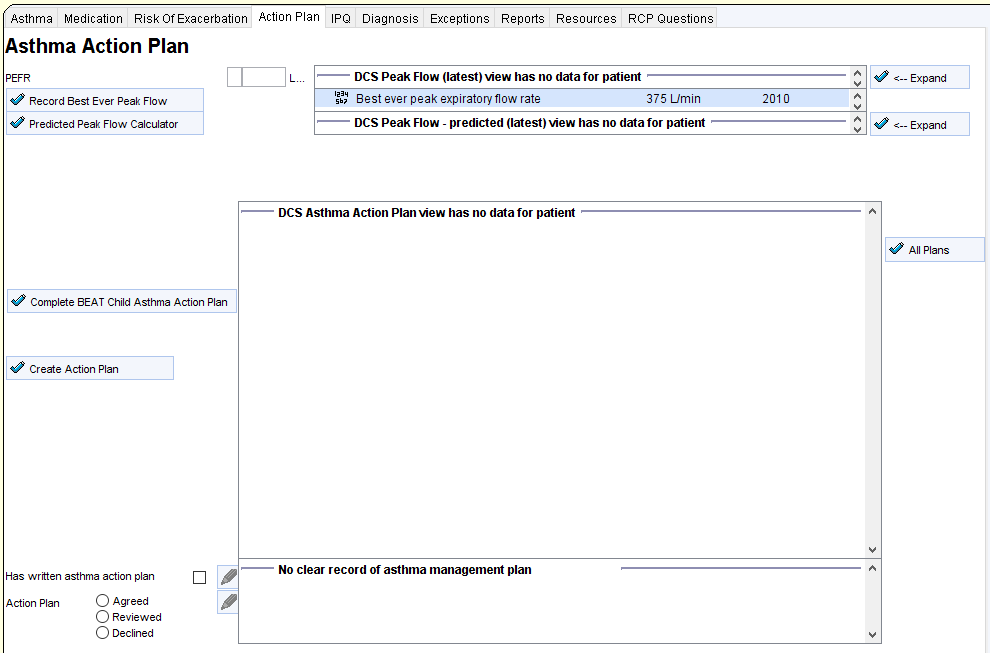
Asthma Medication Risk Of Exacerbation 
Asthma Action Plan 
p EFR 
Record Sest Ever Peak Flow 
Predicted Peak Flow Calculator 
Complete SEAT Child Asthma Action Plan 
Create Action Plan 
Has written asthma action plan 
Action Plan 
IPO Diagnosis Exceptions Reports Resources RCP Questions 
DCS Peak Flow (latest) view has no data for patient 
Best ever peak expiratory flow rate 
375 Limin 
2010 
DCS Peak Flow - predicted (latest) view has no data for patient 
DCS Asthma Action Plan view has no data for patient 
No clear record of asthma management plan 
Expand 
Expand 
All Plans 
Action Plan 
C) Agreed 
o 
Reviewed 
o 
Declined

The peak flow template helps you to record best-ever and recorded peakflows: 
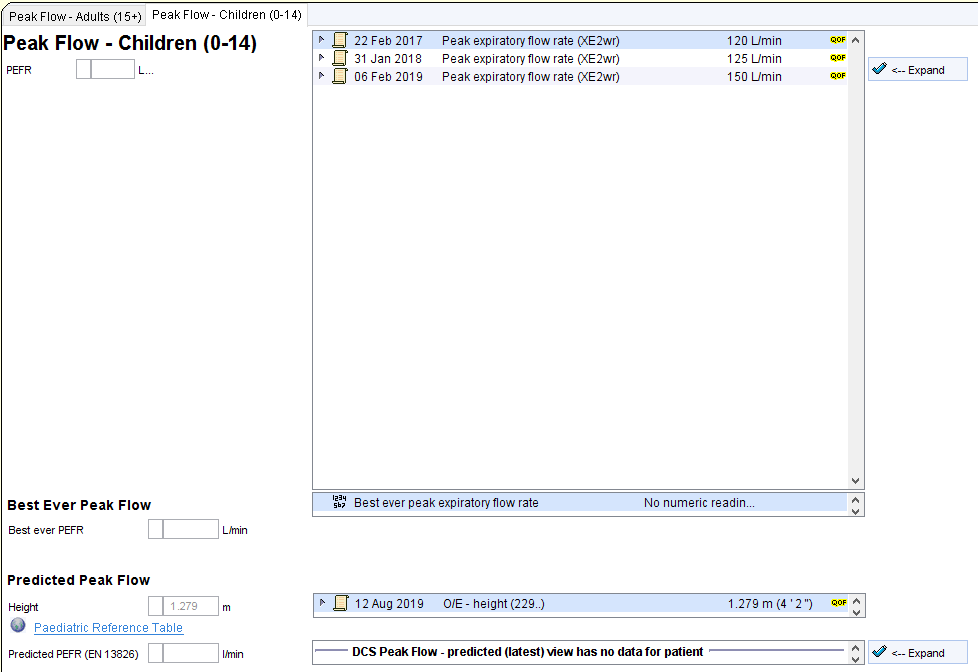
Peak Flow- Adults (1 5+) Peak Flow- Children (0-1 4) 
Peak Flow - Children (0-14) 
2 Feb 2017 
31 dan 2018 
6 Feb 201g 
Peak expiratory flow rate (XE2wr) 
Peak expiratory flow rate OXE2wr) 
PEFR 
Best Ever peak Flow 
aest ever PEFR 
Predicted Peak Flow 
Height 
Paediatric Reference Table 
Predicted PEFR (EN 13826) 
Best ever peak expiratory flow rate 
120 LJmin 
125 Limin 
150 LJmin 
No numeric readim 
1.279 m (4 
Ihin 
12Aug 201g 
OCS Peak Flow 
O/E height 
- predicted (latest) view has no data for patient 
Expand 
Expand
C A Not secure peakflow.com/paediatric_normal_values.pdf 
PAEDIATRIC NORMAL VALUES 
PEAK EXPIRATORY FLOW RATE 
For use With EU / ENI 3826 scale PEF meters only 
Height 
0.85 
0.90 
1.10 
1.15 
1.25 
Height 
29" 
2'11" 
311" 
4'1" 
Predicted EU 
PEFR (Umin) 
87 
95 
104 
115 
127 
141 
157 
174 
192 
Height 
1.30 
1.35 
1.70 
Height 
45" 
57" 
Predicted EU 
PEER (Limn) 
212 
233 
254 
276 
299 
323 
346 
370 
393 
Normal PEF values in children correlate best with height, with increasing age, larger differences occur 
between the sexes These predicted values are based on the formulae given in Lung Function by 
Cotes (Fourth Edition). adapted for ELI scale Mini-Wright peak flow meters by Clement Clarke. 
Date Of preparation — 7th October 2004 
PEAK FLOW METER

To Create An Asthma Care Plan 

If the relevant PEFR results have not already been recorded (they will be shown in the second column), use the buttons to record them.  The care plans can be based on either predicted or best ever PEFR. 

Click on the ‘Complete BEAT Child Asthma Action Plan’ to  complete the action plan questionnaire.  

NB clicking the buttons marked ‘A’ will display common pre-sets to make data entry quicker.   

Once the information is complete, click Save Final Version.  

***The final care plan will not include the information if you do not choose Save Final Version *** 
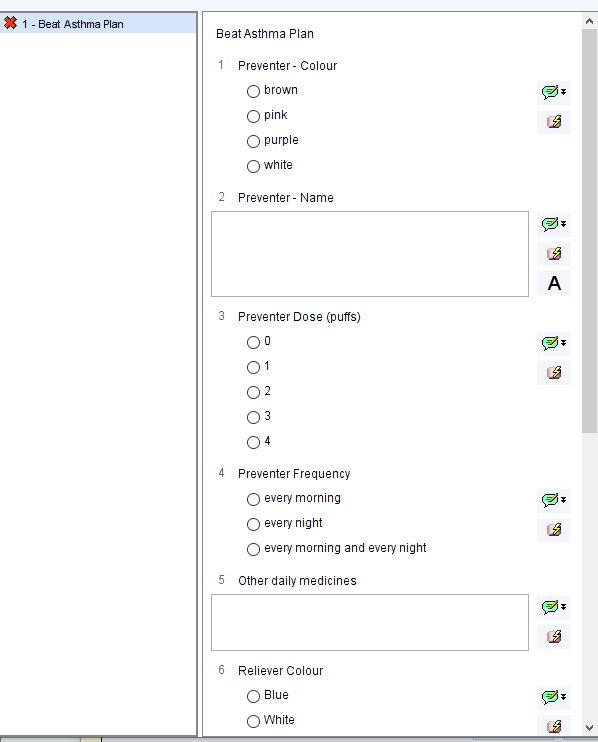
- Seat Asthma Plan 
Beat Asthma Plan 
Preventer- Colour 
O brown 
O pink 
o 
purple 
O white 
Preventer- Name 
Preventer Dose (puffs) 
o 
04 
Preventer Frequency 
O every morning 
O every night 
O every morning and every night 
Other daily medicines 
Reliever Colour 
o 
Blue

If you wish to amend an existing plan, right click on the box in the second column showing the current plan and choose the Copy Questionnaire option, then choose Copy Comments. An editable version of the previous questionnaire will then be displayed. Amend any entries as appropriate, then click Save Final Version. 

Once the questionnaire is complete, click the Create Action Plan button to create a Word care plan (select BEAT Asthma Child Plan when prompted), that can be saved and/or printed/emailed to the patient.   

Use the final tick boxes on this tab to record that the patient has a care plan.  
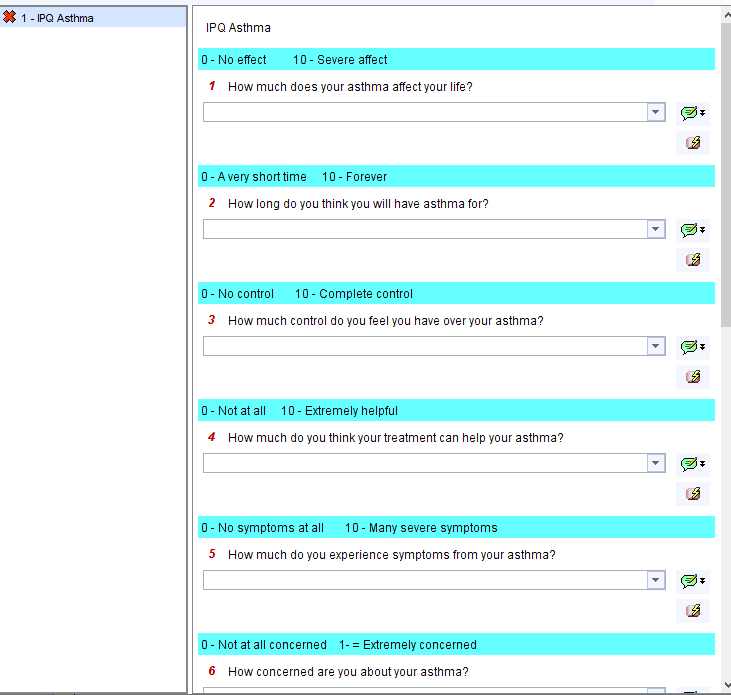
Asthma Illness Perception Questionnaire (IPQ) 

The Asthma IPQ could be completed in advance of the consultation – either by sending out a digital copy to the patient or (if the practice has enabled this functionality – via SystmOnline so the results are automatically saved to the patients records remotely).

- IPQ Asthma 
IPO Asthma 
O- No effect 
10- Severe affect 
1 How much does your asthma affect your life? 
O- Avery short time 10 Forever 
2 How long do you think you will have asthma for? 
O- No control 
10 Complete control 
3 How much control do you feel you have over your asthma? 
O- Not atall 10 Extremely helpful 
4 How much do you think your treatment can help your asthma? 
O- No symptoms at all 
10 Many severe symptoms 
5 How much do you experience symptoms from your asthma? 
O- Not at all concerned 
= Extremely concerned 
6 How concerned are you about your asthma?
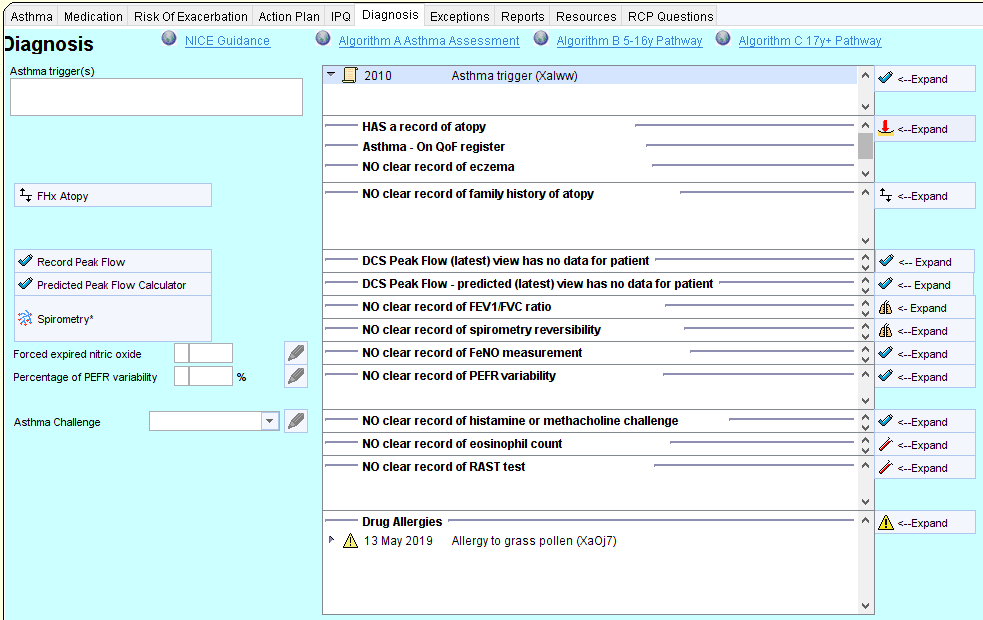
Diagnosis

This page shows the key information required to diagnose asthma. This includes: possible triggers, personal and FHx of atopy, allergy and anaphylaxis; spirometry; FeNO; PEFR variability; asthma challenge results. 

The top of the template has links to the NICE assessment algorithms. 
Asthma Medication 
)iagnosis 
Asthma trigger(s) 
FHx Atopy 
Record Peak Flow 
Risk Of Exacerbation Action Plan IPO Diagnosis Exceptions Reports Resources RCP Questions 
O NICE Guidance 
Alaorithm AAsthma Assessment Alaorithm B 5-1 Pathway 
Alaorithm C 1 7V+ Pathway 
2010 
Asthma trigger (Xalww) 
Predicted Peak Flow Calculator 
Spirometry• 
Forced expired ntric oxide 
Percentage of PEFR variabilty 
Asthma Challenge 
HAS a record of atopy 
Asthma - On QoF register 
NO clear record of eczema 
NO clear record of family history of atopy 
DCS Peak Flow (latest) view has no data for patient 
DCS Peak Flow - predicted (latest) view has no data for patient 
NO clear record of FEVIFVC ratio 
NO clear record of spirometry reversibility 
NO clear record of FeNO measurement 
NO clear record of PEFRvariability 
NO clear record of histamine or methacholine challenge 
NO clear record of eosinophil count 
NO clear record of RAST test 
Drug Allergies 
13 May 201 g Allergy to grass pollen [XaOj7) 
<--Expand 
—Expand 
Expand 
Expand 
Expand 
<--Expand 
--Expand 
--Expand 
--Expand 
<--Expand
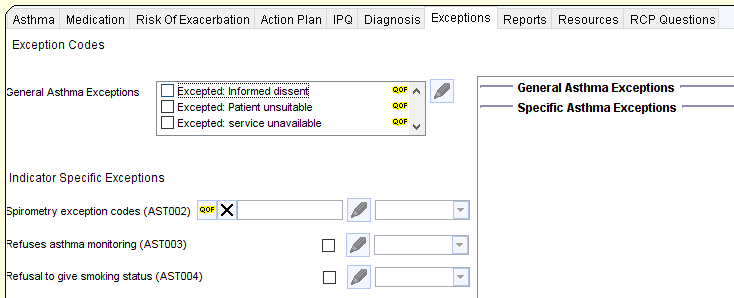
Exceptions

The exceptions allows recording and viewing of asthma exceptions: 
Asthma Medication 
Exception Codes 
Risk Of Exacerbation 
Action Plan 
Diagnosis Exceptions 
Reports 
Resources 
RCP Questions 
General Asthma Exceptions 
*cepted: Informed dissent 
Excepted: Patient unsuitable 
[3 Excepted: service unavailable 
General Asthma Exceptions 
Specific Asthma Exceptions 
Indicator Specific Exceptions 
Spirometry exception codes (AST002) 
Refuses asthma montoring (AST003) 
Refusal to give smoking status (AST004)
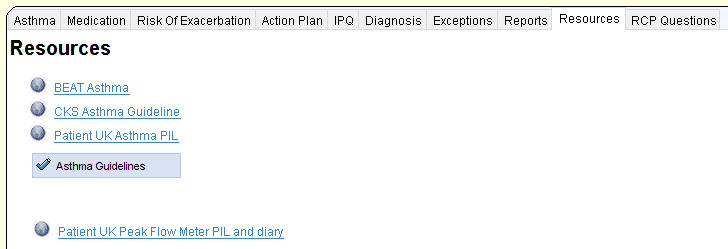
Resources

Links to important resources are shown on this tab. Customised local information can be shown on this tab if required. 
Asthma Medication 
Resources 
BEAT Asthma 
Risk Of Exacerbation 
Action Plan 
Diagnosis 
Exceptions 
Reports 
Resources 
RCP Questions 
CKS Asthma Guideline 
Patient UK Asthma PIL 
Asthma Guidelines 
Patient UK Peak Flow Meter PIL and diarv

Further CDRC Asthma Reports

CDRC has additional reports which are not specific to this project but are specific to patients with asthma and can be used to identify higher risk patients, these reports are found in the folder CDRC Quality > Respiratory.

  • ? Asthma 3.1a >12 SABA in last 12m
  • ? Asthma 3.1b >6 SABA in last 12m
  • ? Asthma 3.1c 7-11 SABA in last 12m
  • ? Asthma 3.2 LABA on repeat and no ICS #
  • ? Asthma 3.3a Likely Severe Asthma (high dose ICS, or LAMA or aminophylline or biologics
  • ? Asthma 3.3b Likely Moderately Severe Asthma #
  • ? Asthma 3.4 – >1 Exacerbation in last 12m.
  • ? Asthma 3.5 Admission or exac in past 2 years but no ICS issued in last 3m #
  • ? Asthma 3.6 Latest ACT <20 #

Further information on these reports can be found here.

Get in touch

If you have any questions regarding access, or the use of the CDRC resources, please get in touch: contact-CDRC@healthinnovationnenc.org.uk


SUBSCRIBE

Keep up to date with CDRC Precision events and new resources

Click here to join our mailing list

Footer

Follow us on social media

  • Facebook
  • LinkedIn
  • Twitter
contact-cdrc@healthinnovationnenc.org.uk
This website is operated by Health Innovation North East and North Cumbria. Suite A, 2nd Floor, 1 Citygate, Gallowgate, Newcastle upon Tyne NE1 4WH. Registered in England and Wales, Company Registration Number: 08727658
  • Terms of Reference
  • Privacy policy
  • Terms of use
  • Cookie Policy (UK)
  • Accessibility Statement

Copyright © 2025 Clinical Digital Resource Collaborative

Manage Consent
We use cookies to optimise our website and our service.
Functional Always active
The technical storage or access is strictly necessary for the legitimate purpose of enabling the use of a specific service explicitly requested by the subscriber or user, or for the sole purpose of carrying out the transmission of a communication over an electronic communications network.
Preferences
The technical storage or access is necessary for the legitimate purpose of storing preferences that are not requested by the subscriber or user.
Statistics
The technical storage or access that is used exclusively for statistical purposes. The technical storage or access that is used exclusively for anonymous statistical purposes. Without a subpoena, voluntary compliance on the part of your Internet Service Provider, or additional records from a third party, information stored or retrieved for this purpose alone cannot usually be used to identify you.
Marketing
The technical storage or access is required to create user profiles to send advertising, or to track the user on a website or across several websites for similar marketing purposes.
Manage options Manage services Manage {vendor_count} vendors Read more about these purposes
View preferences
{title} {title} {title}